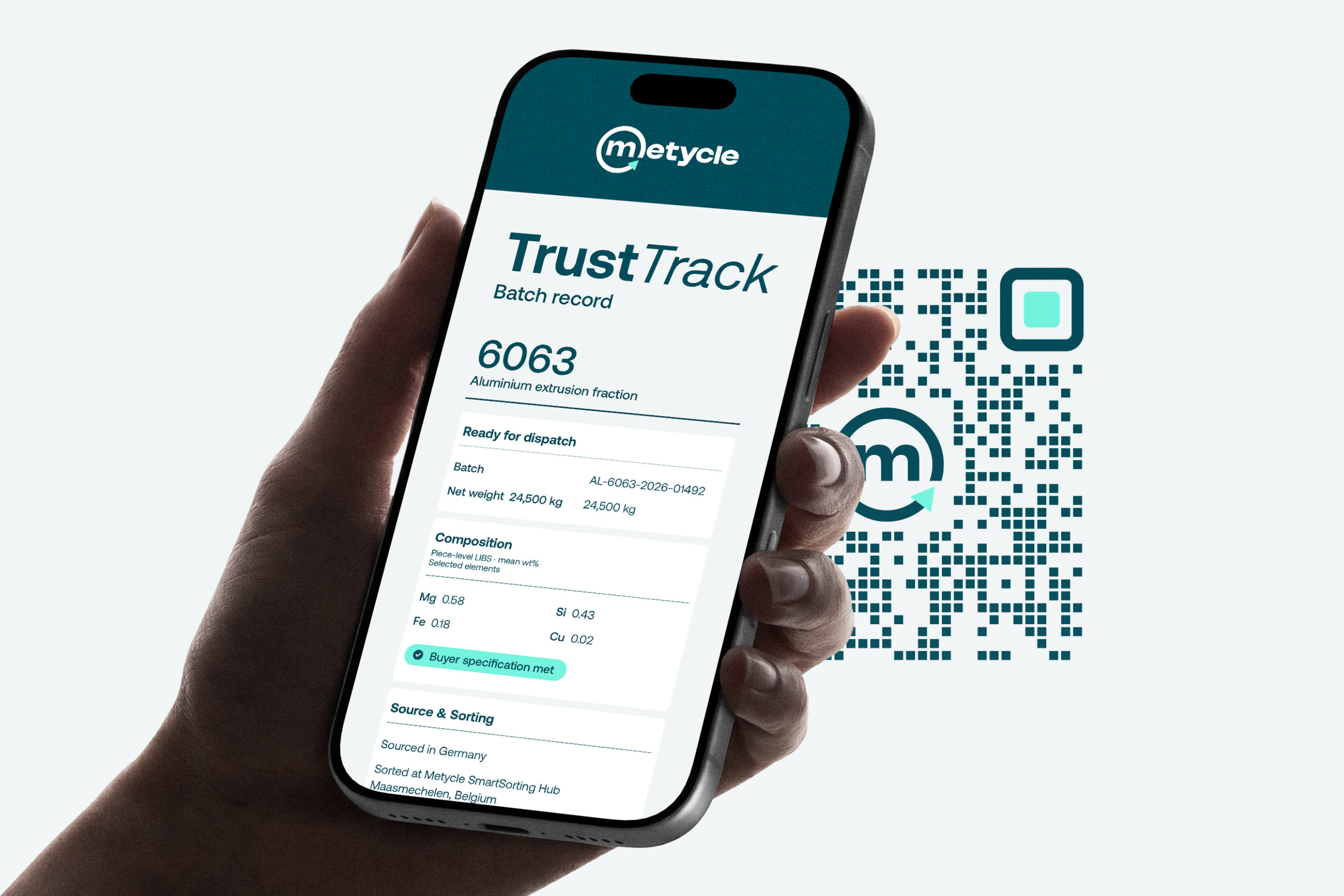

Using AI and data to transform undefined scrap metal into specified and smelter-ready secondary metals: Metycle makes metal recycling smart and transparent.
The basics about secondary metal recycling and trade
Secondary metals are collected and processed at collection yards around the globe. Recycling ratios for metals in most countries have reached very high levels over the past decades. Scrap metal, or secondary metal, is a precious resource used at smelters to close the loop and repurpose it into industrial and consumer products. This process is highly CO₂ effective compared to the primary production of metals, saving up to 95% of emissions. However, large parts of the metal collected are traded inefficiently and through highly complex routes to get further sorted and quality-specified. One of the main challenges in increasing efficiency in metal recycling is to sort and transparently specify the quality and composition of secondary metal. Another inefficiency is that the processing and the related CO₂ savings along the value chain cannot be tracked in today's analogue, multi-level trading processes.
Inefficiencies due to lack of product specification and quality checks
Most secondary metal today is specified by visual, in-person inspection on the yards and sold based on photo or video documentation. Equipment is rarely used to specify product quality, and when it is, the results stay with the supplier and are not shared along the value chain. ISRI specifications help classify the rough composition of material, but no two loads are ever the same. Even within one load of secondary metals, one may find variations in product mix, purity, moisture levels and impurities. In the supply chain, this leads to conservative pricing that assumes the lowest level of product quality, and to frequent product quality claims.
There is significant potential to address these inefficiencies through smart sorting and quality check hubs. Such hubs screen incoming material for composition and quality. The material can be shipped as is to buyers, accompanied by a digital product pass that shows the material composition and allows it to be tracked from source to smelter. This makes it possible to track material flow and processing in real time, and to track the CO₂ savings created from source to smelter. It removes uncertainty about product quality, allowing material to be priced accurately and efficiently, and it removes the need for time-consuming and costly claims.
Producing smelter-ready secondary metal
Smart sorting equipment in recycling facilities uses advanced technologies such as artificial intelligence, machine learning and robotics to sort and separate various types of metal scrap. This equipment sorts accurately and quickly, which drastically improves the efficiency of the recycling process. It uses sensors and complex algorithms to differentiate between metals, allowing for higher quality and purity of the sorted scrap. It also reduces the need for manual labour, resulting in safer and more cost-effective operations. The outcome is smelter-ready material, digitally certified and trackable from source to smelter.
The use of smart sorting equipment in metal recycling combines technological advancement with environmental responsibility. Its contributions to efficient waste management, the production of high-quality recycled metals and improved safety standards are significant. As we look towards a sustainable and efficient future, the role of these technologies in recycling and waste management will only become more critical.
At Metycle we are among the first companies to develop data models, algorithms and AI specifically for secondary metal recycling. Metycle enables the use of smart sorting hubs and equipment at scale. Metycle is digitally transforming secondary metal recycling.